Specifying white marble for hotels and luxury residences
A practical specification follows white marble from intended use through block selection, fabrication and maintenance. Learn what to approve, test and document before installation.
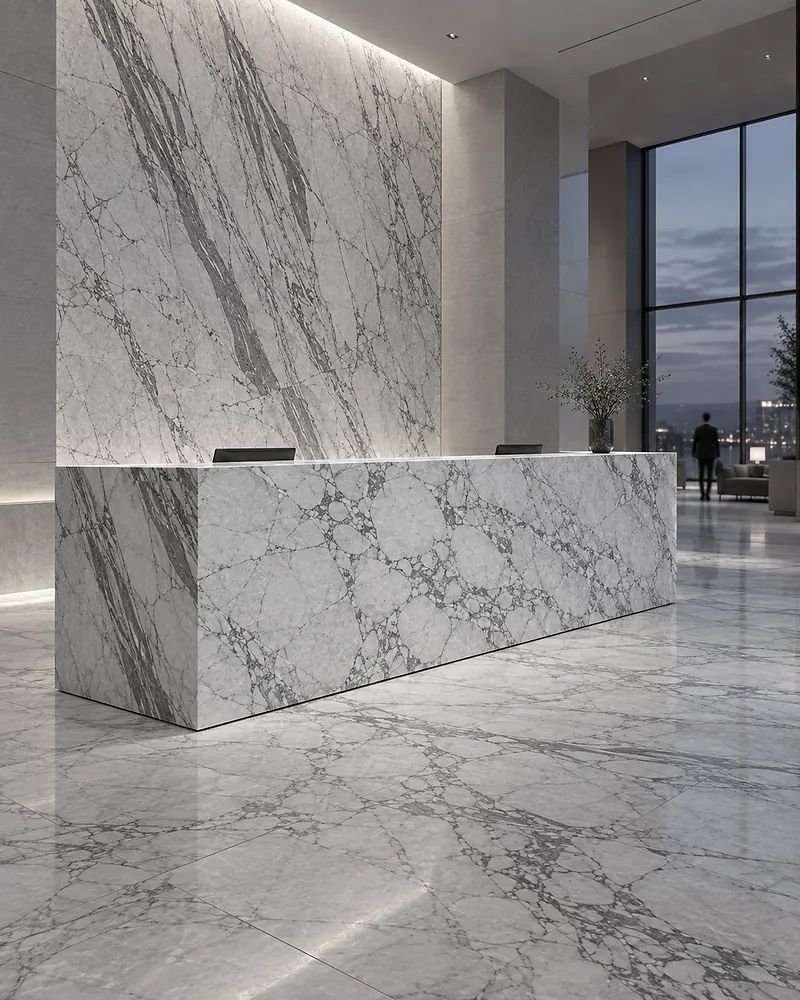
Start a white-marble specification with the room schedule. Marble has established uses in floors, walls, vanities and architectural details, but suitability for a wet area or another demanding location depends on the particular material. Selection needs evidence matched to the intended application.1
For a hotel or residence, set out the visual ambition and operating expectations together. Identify where the stone will be walked on, splashed, cleaned frequently or exposed to food. Then make the approvals follow that sequence: material, performance, fabrication, installation and care.
Give each application its own requirements
Avoid a single undifferentiated “white marble throughout” clause. Prepare a schedule for each stone-and-finish combination, with investigations appropriate to its use. Start from a schedule like this one.
| Location | Resolve before approval |
|---|---|
| Lobby floor or staircase | Abrasion performance, slip testing appropriate to expected conditions, finish and cleaning regime.23 |
| Bathroom or spa floor | Suitability of the specific marble for wet use and slip performance of the proposed finished surface.12 |
| Vanity, kitchen island or hospitality counter | Acceptance of acid etching, likely staining exposures and a practical care plan.3 |
| Feature wall or large cladding panel | Slab layout, thickness, support and anchorage appropriate to the assembly.4 |
Require slip-test evidence alongside finish approval.2 The Natural Stone Institute’s 2022 marble manual recommends a honed finish for commercial marble floors; that recommendation does not establish project-specific slip compliance.4
Ask the hotel operator or homeowner to join this review. Record whether they expect an immaculate surface at every inspection or accept visible ageing. Make that decision before approving marble in a food-service or preparation area.
Approve a representative visual range
Define what “white” means for this project: the acceptable background range, grey movement, inclusions and vein concentration. NSI’s marble guidance calls for samples representing the anticipated colour range and recommends reviewing finished slabs before fabrication.4

Use the sample submission to establish boundaries. Request pieces showing the quieter and more strongly marked material that the supplier proposes to include. Label them, retain the approved set and record any exclusions. Write the selection criteria so that a processor can apply them without having to interpret an adjective such as “luxurious.”
Distinguish the decisions made at different scales. Use the sample set for surface character, slab review for the full pattern, and a project mockup for the relationship between pieces. NSI’s stone-selection framework explicitly includes appearance, finishes, samples and mockups.5
For a hotel, consider approving a complete vanity elevation or a representative stretch of lobby flooring. For a residence, review the island together with its returns and adjacent surfaces. Evaluate the proposal under the intended lighting, with the specified joints and edge details. Write these controls into the procurement documents.
Read the test report in relation to the design
ASTM C503/C503M-23 addresses marble selection through material characteristics, sampling and physical requirements. Its listed properties include absorption, density, compressive strength, modulus of rupture, abrasion resistance and flexural strength. A reference to the standard in a quotation does not demonstrate that the offered material has been tested or complies.6
Request the underlying reports and identify the material sampled. Ask the laboratory to document specimen orientation and wet or dry test conditions, and establish which results are relevant to the proposed application. NSI’s testing programme explicitly distinguishes these conditions and orientations.2
Choose additional investigations by exposure. Anchorage, slip resistance, freeze–thaw durability and thermal/moisture cycling address different questions. Do not use an absorption result as a blanket approval for a wet-area assembly, or a compressive-strength figure as the sole basis for panel design.2
Keep commercial grade and technical classification separate. NSI’s marble soundness groups concern working properties, rather than market value. A highly desirable pattern can therefore require particular fabrication provisions; a visually quiet surface is not, by itself, a technical approval.7
Follow the design back to the rough block
For a processor purchasing blocks against a project, convert the design into a cutting requirement early. EN 1467:2022 distinguishes gross, net and commercial dimensions. State the measurement basis in the purchase documents, together with the usable dimensions needed for the intended pieces.8
Then examine soundness and cutting direction. Research on dimension-stone extraction shows that discontinuity spacing and orientation influence recoverable block geometry. The practical implication is straightforward: assess the block against the proposed output, rather than treating its enclosing volume as guaranteed finished material.9
Give the receiving processor the room schedule, largest required pieces and visual references before selection. Ask for an explicit cutting proposal, including which faces will establish the principal vein direction. Keep the block identifier connected to the inspection record and subsequent slab sequence. Agree how newly revealed internal features will be reviewed after sawing; a face photograph cannot establish the geometry of every concealed discontinuity.89
Where book-matching is specified, reserve the actual composition for approval. The technique uses adjacent slabs with corresponding opposing faces finished and opened like a book. Sawing removes material between those faces, while natural patterns change through the block, so the result is approximate symmetry.10
Review the proposed arrangement with basins, sockets, door openings and panel joints drawn over it. Decide where visual continuity matters most, and identify acceptable alternatives before cutting. For procurement comparisons, request a cost for the acceptable finished scope, with the processor’s recovery assumptions stated.
Specify the installation as carefully as the surface
Require shop drawings showing piece dimensions, thickness, jointing, bedding and anchorage. These are explicit elements of NSI’s marble specification guidance. Allocate responsibility for the engineering and approval of the assembly before releasing fabrication.4
Ask the processor to declare resin backing, reinforcement mesh and other treatments, and submit representative material for compatibility review. LATICRETE’s technical guidance identifies two separate concerns with resin-backed stone: adhesion to the backing and the backing’s own attachment to the stone. A satisfactory bond at one interface cannot establish the performance of the other.11
Obtain a written installation recommendation for the actual stone, backing and substrate. Do not authorize an adhesive substitution solely because its packaging says “natural stone.” Identify who must approve a change, and what evidence they require.
For white or light-coloured marble, NSI recommends white Portland cement where that setting system is used, together with nonstaining installation materials. Treat this as part of material compatibility, rather than a complete installation prescription.4
Build the agreed mockup using the proposed stone, adhesive or mortar, grout, joint sealant and any surface treatment. Record its acceptance and retain it as the reference. Include movement-joint detailing in the installation review; the resin-backed-stone guidance also emphasizes preserving these joints within the installation and around its perimeter.11
Agree on etching, staining and care
Acid sensitivity deserves an explicit conversation. Lemon juice, vinegar and acidic cleaning products can etch calcareous stone. Etching changes the surface finish; staining causes discolouration. The same spill can produce both, but cleaning a stain and restoring an etched finish are different tasks.3
An impregnating sealer can improve stain resistance; it does not make marble stain-proof or provide ordinary protection against acid etching. Some stones may not need sealing. Select the treatment and maintenance frequency with the stone supplier and product manufacturer rather than imposing a universal annual schedule.3
Before approving a counter or vanity, ask for a practical exposure trial on representative finished samples. Agree the substances, contact periods, cleaning method and acceptable result with the relevant specialists. Use likely project exposures, including the operator’s intended cleaners. Keep this exercise separate from formal laboratory testing: its purpose is to make the owner’s expectations explicit.
Put the care instructions into the handover documents. NSI recommends neutral cleaners, prompt attention to spills and regular removal of abrasive grit from floors. Etched areas may need professional refinishing or repolishing.3
Name the party responsible for training housekeeping staff or briefing the homeowner. Agree when specialist inspection should be requested and how replacement pieces will be identified. Give the maintenance team the approved product list before occupation.
Make the final approval traceable
Close the specification with a clear approval record. Require the accepted visual range, relevant test reports, treatment declarations, slab allocation, shop drawings, mockup acceptance and care instructions. Assign an approver to each item. Where evidence remains outstanding, state the condition that must be satisfied before the next stage proceeds.
For phased work, agree how later selections will be assessed against the original range. Consider reserving identified replacement pieces and documenting their intended locations. Do not promise an invisible future match: the changing natural patterns visible in sequential slabs make that a matter for actual material review.10
MAMSALEH supplies Scatto & Bianco primarily as rough blocks from Aligoodarz, Lorestan, Iran. Its bright white background, crystalline character and natural veining provide the starting point for selection, subject to quarry availability.12
For block inquiries, share the required dimensions, quality, background and veining preferences through the WhatsApp or phone contacts on mamsaleh.com.12
Sources
Superscript numbers in the text refer to these sources.
- 1Natural Stone Institute. Marble, Onyx and Serpentine: applications and characteristics (opens in a new tab). Undated. Accessed 2026-09-29.
- 2Natural Stone Institute. Natural Stone Testing Services (opens in a new tab). Undated live technical resource. Accessed 2026-09-29.
- 3Natural Stone Institute. Care & Cleaning of Natural Stone (opens in a new tab). Undated. Accessed 2026-09-29.
- 4Natural Stone Institute. Dimension Stone Design Manual: Marble and Onyx (opens in a new tab). 2022 edition, particularly samples, shop drawings, finishes and installation materials. Accessed 2026-09-29.
- 5Natural Stone Institute. Resource Library: Dimension Stone Design Manual 2024, Chapter 03: Stone Selection (opens in a new tab). Public chapter description, listed 2025-01-08. Accessed 2026-09-29.
- 6ASTM International. C503/C503M-23: Standard Specification for Marble Dimension Stone (opens in a new tab). 2023 edition; public abstract and scope. Accessed 2026-09-29.
- 7Natural Stone Institute. Marble Soundness Classification (opens in a new tab). Undated. Accessed 2026-09-29.
- 8CEN / Slovenian Institute for Standardization, via iTeh. EN 1467:2022: Natural stone: Rough blocks: Requirements (opens in a new tab). 2022 edition. Accessed 2026-09-29.
- 9Mosch et al.; Environmental Earth Sciences, Springer Nature. Optimized extraction of dimension stone blocks (opens in a new tab). Published online 2010-11-30; 2011 journal issue. Accessed 2026-09-29.
- 10Karin Kirk; Use Natural Stone / Natural Stone Institute. Bookmatching: Geology Meets Geometry (opens in a new tab). Published 2018-12-21. Accessed 2026-09-29.
- 11LATICRETE Australia. Installation of Resin-Backed Tile and Stone, TDS-1150-0920 (opens in a new tab). 2020 technical data sheet; manufacturer guidance. Accessed 2026-09-29.
- 12MAMSALEH. Scatto & Bianco: product and supply information. mamsaleh.com, 2026.