Lorestan and Aligoodarz: a stone region explained
What does an Aligoodarz origin tell a marble buyer? This guide connects regional geology and quarrying history with practical questions for block selection and architectural specification.
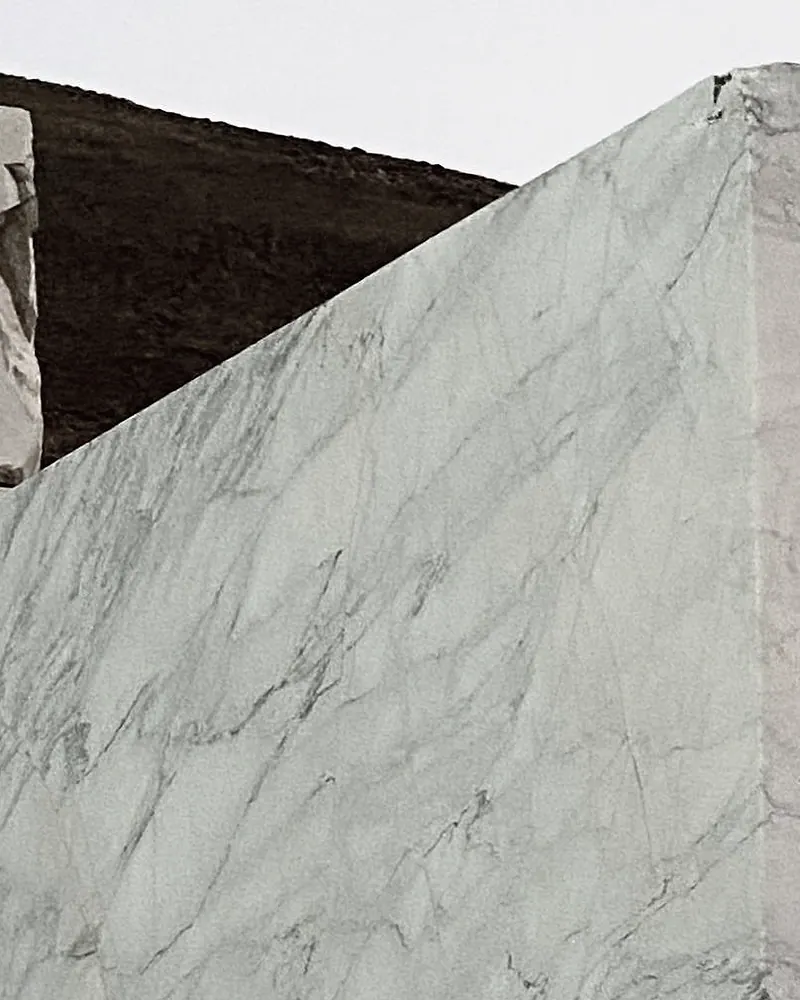
Aligoodarz’s place in the stone trade becomes clearer when three things are kept separate: regional geology, quarry production and the individual block offered for sale. Located in Lorestan Province, Iran, the area has documented marble occurrences within the wider Aligudarz–Khonsar metamorphic region. A local quarry operator also describes white and grey commercial blocks with plain and veined appearances.123
That evidence gives importers, processors and architects a useful starting point. A purchasing inquiry should then establish the named quarry, the blocks available, their usable dimensions and the evidence supporting the intended application. Origin belongs in that record alongside inspection and testing.45
A varied geological setting
Research published in Petrology in 2016 places the Aligudarz–Khonsar region within the Sanandaj–Sirjan zone. Karimi and Tabatabaei Manesh identify marble alongside slates, several varieties of schist and mylonitic granite. Their work describes a region affected by successive episodes of metamorphism and deformation.2
The paper establishes a regional context for marble occurrence. Its detailed pressure–temperature findings concern studied rocks, including metapelites; they cannot be assigned to a particular white-marble product without evidence linking that material to the analysis.2
For buyers, the practical distinction is between identifying where a stone comes from and establishing what it contains. Grey veining in a photograph is insufficient evidence for naming the minerals responsible. Where mineral composition matters to a specification, request representative petrographic or other appropriate laboratory evidence. The Natural Stone Institute’s testing framework includes methods for investigating stone composition and performance.5
Keep geological descriptions precise in translated documents, too. A quarry name, a commercial product name and a laboratory identification should occupy separate fields in the procurement record. That keeps origin, appearance and tested characteristics apart.45
What local quarry descriptions establish
One local operator describes an open-pit operation using diamond wire, producing blocks across white and grey colour ranges with varying patterns. The operator calls the material chini in its Persian description and also identifies it as marble.3
That account supplies a concrete example of local commercial practice. It supports discussion of diamond-wire extraction at that operation, while leaving the equipment and methods of other quarries to their own documentation. Likewise, the term chini should be accompanied by the offered material’s identification and test evidence when a buyer needs to establish technical suitability.35
For an inquiry headed “Aligoodarz white marble,” ask the supplier to identify the precise quarry and commercial selection. Then connect those descriptions to block identifiers, photographs and the proposed measurement basis. EN 1467, the European rough-block standard, addresses origin, identification, appearance and dimensions; these provide a useful structure for making an origin claim commercially specific.4
Stone heritage and modern quarrying
Lorestan’s historic bridges offer another view of the province’s stone resources. A 2024 study by Abdi and Sabzi examines Asmari and Talezang limestones used in these structures, investigating deterioration under salt crystallization. The materials studied are limestones, distinct from the marble documented in the Aligudarz–Khonsar geological research.26
The bridge study documents a building-stone heritage and a conservation problem. It does not establish that today’s white-marble quarries supplied those structures, or that commercial extraction of the same marble has continued since antiquity.6
There is firmer company-level evidence for modern activity. One local quarrying company’s published history records registration in Persian year 1379 and the start of activity in 1380, approximately 2001. It describes stone extraction beginning after the acquisition of machinery. These dates belong to that company’s account; they do not date the opening of the entire district.7
The published record does not say when commercial white-marble extraction began in Aligoodarz. An accurate regional history can acknowledge both historic stone construction and documented modern quarrying without inventing continuity between them.67
Reading the quarry through the block
For a processor, geological structure becomes commercially important through recoverable dimensions. Research on dimension-stone extraction shows that the orientation and spacing of fractures influence the size and shape of usable blocks. A substantial rock face may contain discontinuities that limit the sound pieces recoverable from it.8

This is why a block inquiry should distinguish the outer dimensions from the usable volume. EN 1467 separates gross, net and commercial dimensions: the enclosing form, the usable inscribed form and dimensions incorporating agreed allowances. The measurement basis should accompany the quotation, particularly where irregular edges or defects require deductions.4
The table below turns regional interest into evidence that a buyer and processor can review together.458
| Selection issue | Evidence to request |
|---|---|
| Origin and identity | Named quarry and a unique block identifier linked to the offer and inspection record.4 |
| Usable geometry | Measured dimensions, the measurement basis and agreed allowances for irregularities.4 |
| Background and pattern | Views of accessible faces and representative samples showing the accepted visual range.4 |
| Structural condition | Recorded fractures and other discontinuities, with the receiving processor’s assessment of their significance.58 |
Appearance and working properties deserve separate judgments. The Natural Stone Institute’s marble soundness classification addresses fabrication characteristics and expressly separates them from market value. A visually desirable marble can require demanding processing; an attractive face alone does not settle suitability for a particular application.59
For an importer, the practical response is to define acceptance before reservation. Agree the permissible background range, vein intensity, dimensions and disclosed structural features. Keep that agreement attached to the selected block identifiers so that the purchasing decision remains traceable to the material inspected.49
Carrying regional character into a project
The architectural expression of a patterned marble also depends on how it is cut. The Natural Stone Institute’s design manual distinguishes cutting approaches in relation to stone structure. The proposed orientation should therefore be discussed with the processor using the actual block.10
For a proposed lobby feature wall, for example, ask for an agreed cutting direction and a slab layout before approving the composition. Where book-matching is intended, adjacent slabs and the corresponding finished faces form the approximately mirrored arrangement. Natural variation through the block and material removed during sawing mean that matching requires review of the actual sequence.11
A physical reference sample should also carry an approved finish. Polished marble has a reflective surface; honing produces a smooth surface with little or no gloss. Finish affects the presentation of colour and veining, so the approved appearance should correspond to the proposed fabrication.10
Technical approval needs its own documentation. ASTM C503/C503M-23 addresses marble dimension stone, including absorption, density and several strength and abrasion properties. A specification citing it should request relevant results for the material offered. Merely naming the standard establishes no tested compliance.12
The intended assembly determines what further investigation is useful. Cladding may require anchorage assessment; walking surfaces may require slip-resistance evaluation; exterior exposure can introduce weathering and thermal or moisture concerns. The Natural Stone Institute lists distinct methods for these questions. Regional origin cannot substitute for the appropriate investigation.5
Maintenance should be resolved at the same stage. Marble’s carbonate chemistry makes acidic spills and cleaners a concern: etching changes the surface, while staining involves discolouration. Impregnating sealers can improve stain resistance but should not be represented as protection against acid etching. For a hotel vanity or food-service surface, agree cleaning methods and acceptable wear using representative samples before final selection.13
An inquiry grounded in the source
A procurement file can also ask for evidence of the operation behind the block: water management, excess-material handling, energy use and quarry rehabilitation planning. These are among the topics in the Natural Stone Institute’s responsible-manufacturing framework. Assess them through site-specific records, with the same care used to assess appearance and physical properties.14
For the commercial discussion, send the intended output first: slab dimensions, proposed application, preferred background and vein character. Ask the supplier and processor to respond against those requirements with identifiable available blocks, a measurement basis and an agreed inspection record.458
Within Aligoodarz, MAMSALEH describes Scatto & Bianco as a bright white, crystalline natural stone with naturally formed veining. Its current direct supply is primarily rough blocks, with selection coordinated around dimensions, quality, background and veining, subject to quarry availability.1
For MAMSALEH block inquiries, use the WhatsApp or phone contacts on the company website, with your preferred dimensions, background and veining.1
Sources
Superscript numbers in the text refer to these sources.
- 1MAMSALEH. Scatto & Bianco: product and supply information. mamsaleh.com, 2026.
- 2Karimi, S., and Tabatabaei Manesh, S. M.; Petrology, Springer Nature. Metamorphic rocks of the Aligudarz–Khonsar region (opens in a new tab). Published 2016-01-06. Accessed 2026-09-29.
- 3A quarry operator in Aligoodarz County. Published description of its open-pit operation. Operator account, Persian. Accessed 2026-09-29.
- 4CEN / Slovenian Institute for Standardization; iTeh preview. EN 1467:2022: Natural stone: Rough blocks: Requirements (opens in a new tab). 2022 edition. Accessed 2026-09-29.
- 5Natural Stone Institute. Natural-stone testing services and methods (opens in a new tab). Live technical resource. Accessed 2026-09-29.
- 6Abdi, Y., and Sabzi, M.; Geoheritage, Springer Nature. Salt crystallization and heritage limestones in Lorestan (opens in a new tab). Published 2024-10-07. Accessed 2026-09-29.
- 7A quarrying company in Aligoodarz County. Published company history. Company account, Persian. Accessed 2026-09-29.
- 8Mosch et al.; Environmental Earth Sciences, Springer Nature. Optimized extraction of dimension-stone blocks (opens in a new tab). Published online 2010-11-30; 2011 journal issue. Accessed 2026-09-29.
- 9Natural Stone Institute. Marble Soundness Classification (opens in a new tab). Undated. Accessed 2026-09-29.
- 10Natural Stone Institute. Dimension Stone Design Manual: Marble and Onyx (opens in a new tab). 2022. Accessed 2026-09-29.
- 11Kirk, Karin; Use Natural Stone / Natural Stone Institute. Bookmatching: Geology Meets Geometry (opens in a new tab). Published 2018-12-21. Accessed 2026-09-29.
- 12ASTM International. C503/C503M-23: Marble Dimension Stone (opens in a new tab). 2023 edition. Accessed 2026-09-29.
- 13Natural Stone Institute. Care and Cleaning of Natural Stone (opens in a new tab). Undated. Accessed 2026-09-29.
- 14Natural Stone Institute. Responsible manufacturing practices for quarriers and fabricators (opens in a new tab). Undated. Accessed 2026-09-29.