Iran’s natural stone industry: scale, strengths and challenges
A practical reading of Iran’s reported output, regional stone resources and export trade. Learn what to establish before committing to blocks or finished material.
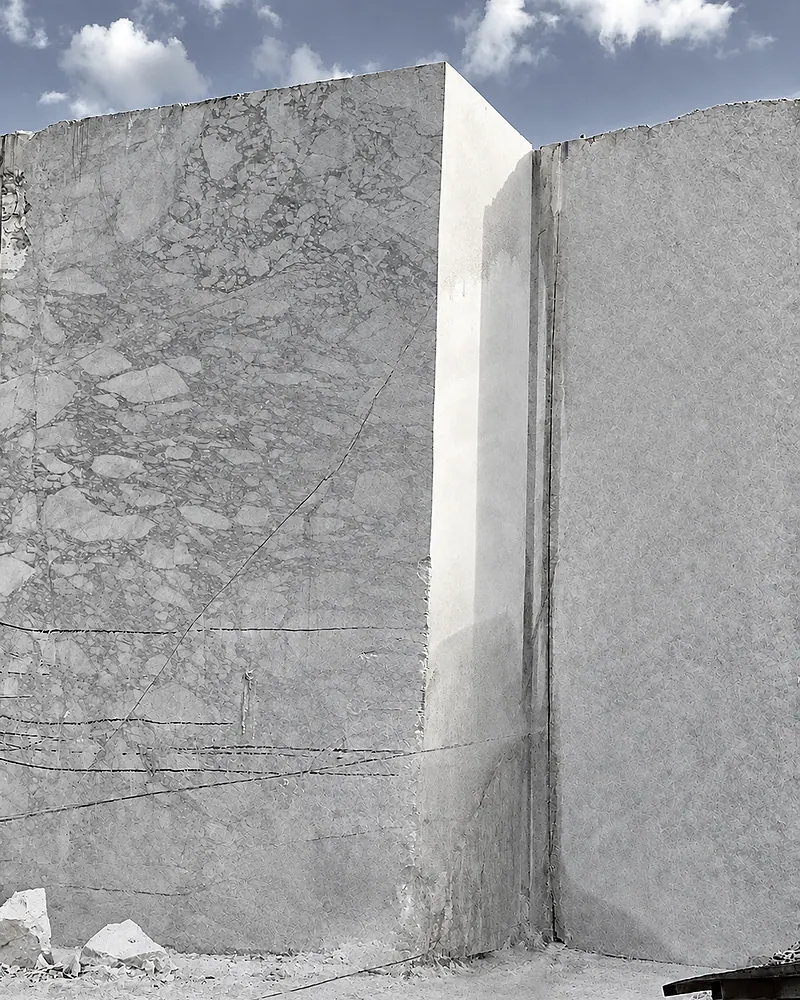
Iran’s natural-stone trade serves both overseas block processors and buyers of worked architectural stone. Historical customs records show different destination patterns, alongside industry reports of a substantial extraction and processing base.123
For a processor, the decisive question is how much acceptable finished stone a selected block can produce. For an architect, it is whether the proposed material meets the project’s visual and technical requirements. National output figures provide context; block geometry, geological discontinuities and representative testing provide evidence for those decisions.45
Scale: read the date and the definition
In April 2023, Iran Stone Association chairman Bahram Shakouri reported average decorative-stone extraction of approximately 10–11 million tonnes annually, alongside more than 6,000 mining and processing units. The latter figure combines activities: it should never be presented as a count of operating quarries. Both numbers remain attributed industry estimates from that period.3
A May 2023 report quoted the same chairman putting annual decorative-stone export earnings at US$300–350 million. His separate US$5 billion figure described export potential. The reports do not provide the product-code coverage and reporting-period detail needed to reconcile these statements with a complete customs series. They cannot establish current export earnings.36
There is also a significant independent statistical limitation. The US Geological Survey’s Iran production table, covering 2020–2024 with information available through 3 February 2026, says available evidence was inadequate to estimate dimension-stone output reliably. It therefore does not validate a current national total or a precise world ranking.7
For procurement, keep three measures separate: extracted tonnage, active commercial capacity and export sales. A national extraction estimate cannot establish the quantity, grade or delivery schedule available from an individual supplier. The published figures are background for sourcing, not a substitute for an offer tied to identified material.37
Regional diversity gives buyers specific choices
The geological evidence supports a varied material base. Research on the Aligoodarz–Khonsar region identifies marble among its metamorphic rocks. At Mahallat, geothermal research documents travertine associated with hot springs and fault-controlled circulation. Studies of Neyriz examine a marble quarry, while research around Alvand, near Hamadan, documents granitic rocks. These are distinct geological settings with different materials.891011
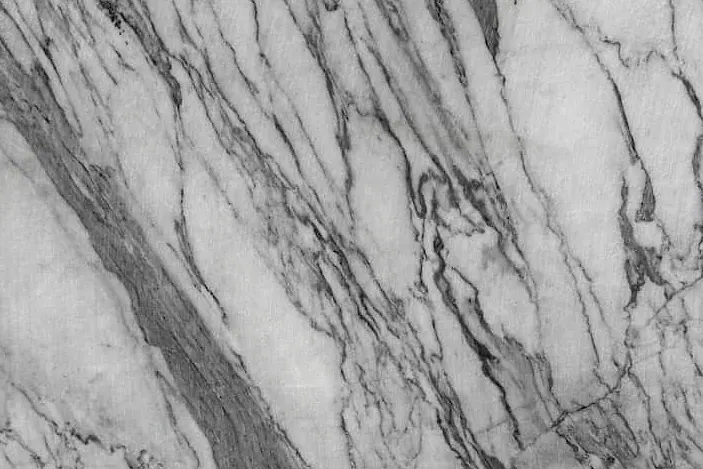
Isfahan’s Lashotor quarry complex provides another useful example: researchers have investigated how discontinuities affect recoverable blocks and production planning there. Such work connects a regional name to a practical quarrying question (what sound geometry can actually be recovered) without pretending to measure an entire province’s output.12
This diversity gives an importer several material families to investigate. It also makes precise identification essential. Regional geology does not certify the absorption, strength or mineral composition of a commercial product. For marble, ASTM C503/C503M addresses material characteristics, physical requirements and sampling; representative test results still need to accompany the proposed stone.58911
Ask for the quarry origin and the actual selection under discussion. A province name is useful provenance, but acceptance should be tied to the stone offered, its appearance and its relevant characteristics.13
Export destinations depend on the product
WITS/UN Comtrade records illustrate the distinction. These figures cover specific customs categories in different years; they cannot establish current destination rankings or total national stone exports.12
| Iranian export category | Recorded export value | Selected destinations by value |
|---|---|---|
| HS 251511, 2022: crude or roughly trimmed marble and travertine | US$40.787 million | China US$27.469m; India US$8.568m; Turkey US$1.439m.1 |
| HS 680291, 2023: other worked marble, travertine and alabaster building stone | US$69.467 million | Iraq US$47.965m; UAE US$8.516m; Turkey US$3.737m; Oman US$0.815m.2 |
These records suggest distinct commercial relationships: rough-material demand in China and India, and regional demand for worked products, particularly in Iraq within the cited category. Any statement about Iran’s largest stone customer must retain its year and product definition.12
Neither heading isolates white marble, a brand or a grade. The rows cannot establish a national processing share because their periods and coverage differ. Buyers need material-specific comparisons.12
Processing adds value when it serves a market
Iran’s rough-versus-processed balance remains unsettled in the available evidence. In a September 2025 interview, the Iran Stone Association secretary reported an approximately two-to-one relationship between cut-stone and block exports on a weight basis over the preceding years. The wording is imprecise and the interview supplies no supporting customs calculation. It is an association statement, not a verified national ratio.14
The interview identifies investment, equipment renewal, specialist labour and dependable orders as requirements for expanding finished exports. It also recognizes buyers who want fabrication closer to their projects, giving blocks a continuing commercial role.14
For a processor comparing those options, evaluate the complete conversion cost: purchase, freight, sawing, trimming, treatment where required and the quantity of acceptable output. Fractures and their orientation affect recoverable block geometry. A lower purchase price per tonne can lose its advantage if the intended slab dimensions require extensive rejection or trimming.4
For an exporter considering further processing, ask whether an identified buyer will pay for the proposed dimensions, finish and selection. The association’s emphasis on orders and sales networks supports testing demand before investing.14
Payment and transport need current confirmation
The association reports banking restrictions, international-payment difficulties, foreign-exchange obligations, high transport costs and customs delays. These are sector concerns, not findings about every supplier. As a purchasing response, specify quotation currency, validity, payment milestones and responsibilities explicitly, and confirm the proposed arrangements before committing.14
Sanctions require separate, transaction-specific attention. OFAC’s guidance on Executive Order 13902 covers Iran’s mining and manufacturing sectors; its mining definition includes extraction of geological materials. The Council of the European Union also reimposed nuclear-related restrictive measures in September 2025, including financial and transport measures. These sources establish relevant restrictions and exposure, rather than a blanket verdict on an individual stone purchase. Buyers should follow the laws of their own jurisdiction and applicable transaction requirements.1516
Shipping assumptions also need a date. Maersk’s 23 September 2026 regional notice records changing Gulf booking restrictions and service arrangements, expressly subject to availability and applicable law. It does not establish carrier acceptance or an available route for Iranian stone. Historical exports to a destination cannot be treated as a present delivery promise.17
Request current confirmation of cargo acceptance, handling requirements and the proposed schedule from the responsible transport parties. Keep that confirmation separate from product approval. Incoterms allocate delivery obligations, costs and risk, but do not settle product quality, payment or ownership, and cannot create legal permission for a transaction.15161718
Supplier evidence makes the opportunity assessable
Translate the national picture into an inspectable purchase. For rough blocks, EN 1467:2022 distinguishes gross, net and commercial dimensions and addresses identification, origin and appearance. Agree the measurement basis before comparing quotations: a block’s enclosing dimensions and its usable dimensions answer different questions.13
An inspection record should connect the block identifier to dimensions, photographs of accessible faces, visible defects, intended cutting direction and acceptance criteria. Exterior inspection cannot reveal every internal discontinuity.413
For architectural work, ask the receiving processor to relate the selected material to the intended application and relevant tests. Approving colour and veining does not answer questions about absorption or strength. Equally, a test result cannot define the acceptable visual range for a large installation; document both.513
Environmental assessment belongs at this supplier level too. The Natural Stone Institute’s responsible-manufacturing framework addresses water, energy, excess material, worker welfare and quarry closure. Request evidence of the practices relevant to the operation being considered. National origin alone supplies no basis for claiming recycled-water rates, certification or a particular environmental footprint.19
MAMSALEH offers Scatto & Bianco from Aligoodarz, Lorestan: a bright white, crystalline natural stone with naturally formed veining, supplied primarily as rough blocks. Selection can be coordinated around dimensions, quality, background and veining, subject to quarry availability. For block inquiries, use the WhatsApp or phone contacts at mamsaleh.com.20
Sources
Superscript numbers in the text refer to these sources.
- 1World Bank WITS / UN Comtrade. Iran: crude or roughly trimmed marble and travertine exports by destination, HS 251511, 2022 (opens in a new tab). Dynamic database. Accessed 2026-09-29.
- 2World Bank WITS / UN Comtrade. Iran: other worked marble-family stone exports by destination, HS 680291, 2023 (opens in a new tab). Dynamic database. Accessed 2026-09-29.
- 3Tasnim News Agency. Iran’s decorative-stone extraction and export potential (opens in a new tab). Published 2023-04-10. Statements attributed to Iran Stone Association chairman Bahram Shakouri. Accessed 2026-09-29.
- 4Mosch et al.; Environmental Earth Sciences, Springer Nature. Optimized extraction of dimension-stone blocks (opens in a new tab). Published online 2010-11-30; 2011 journal issue. Accessed 2026-09-29.
- 5ASTM International. C503/C503M-23: Standard Specification for Marble Dimension Stone (opens in a new tab). 2023 edition. Accessed 2026-09-29.
- 6Tasnim News Agency. 13th International Stone Exhibition opens in Tehran (opens in a new tab). Published 2023-05-29; includes attributed export-earnings estimates. Accessed 2026-09-29.
- 7US Geological Survey. Iran: mineral-industry report and production table (opens in a new tab). Table covers 2020–2024; information available through 2026-02-03. Accessed 2026-09-29.
- 8Karimi and Tabatabaei Manesh; Petrology, Springer Nature. Metamorphic rocks of the Aligudarz–Khonsar region (opens in a new tab). Published 2016-01-06. Accessed 2026-09-29.
- 9Ebrahimi and Nouraliee; Niroo Research Institute / World Geothermal Congress. Mahallat geothermal-field investigation (opens in a new tab). 2021 congress publication. Accessed 2026-09-29.
- 10Doghozlou et al.; Environmental Earth Sciences, Springer Nature. Spalling failure at Neyriz marble mine (opens in a new tab). Published 2016-11-26. Accessed 2026-09-29.
- 11Shafiei, Heidari and Dusseault; Taylor & Francis/Balkema. Weathering and geomechanical properties of Alvand granitic rocks (opens in a new tab). 2007; university repository record. Accessed 2026-09-29.
- 12Jalalian, Bagherpour and Khoshouei; Rudarsko-geološko-naftni zbornik. Discontinuities and production planning in dimension-stone quarries (opens in a new tab). Published 2024-04-28. Accessed 2026-09-29.
- 13CEN / Slovenian Institute for Standardization; iTeh preview. EN 1467:2022: Natural stone: Rough blocks: Requirements (opens in a new tab). 2022 edition. Accessed 2026-09-29.
- 14Tasnim News Agency. Interview with the Iran Stone Association secretary on block exports, processing and commercial constraints (opens in a new tab). Published 2025-09-27; Persian-language interview. Accessed 2026-09-29.
- 15US Department of the Treasury, Office of Foreign Assets Control. FAQ 831: Iranian economic sectors under Executive Order 13902 (opens in a new tab). Dated 2020-12-07. Accessed 2026-09-29.
- 16Council of the European Union. Iran sanctions snapback: Council reimposes restrictive measures (opens in a new tab). Published 2025-09-29. Accessed 2026-09-29.
- 17Maersk. Middle East Operational Update 49 (opens in a new tab). Published 2026-09-23. Accessed 2026-09-29.
- 18International Chamber of Commerce. Incoterms 2020 questions and answers (opens in a new tab). Undated online guidance. Accessed 2026-09-29.
- 19Natural Stone Institute. Responsible manufacturing: best practices for quarriers and fabricators (opens in a new tab). Undated. Accessed 2026-09-29.
- 20MAMSALEH. Scatto & Bianco: product and supply information. mamsaleh.com, 2026.