The state of the global natural-stone market in 2026
This review examines trade flows, architectural demand and regulation through the evidence available in September 2026. It explains what buyers should verify before committing to natural stone.
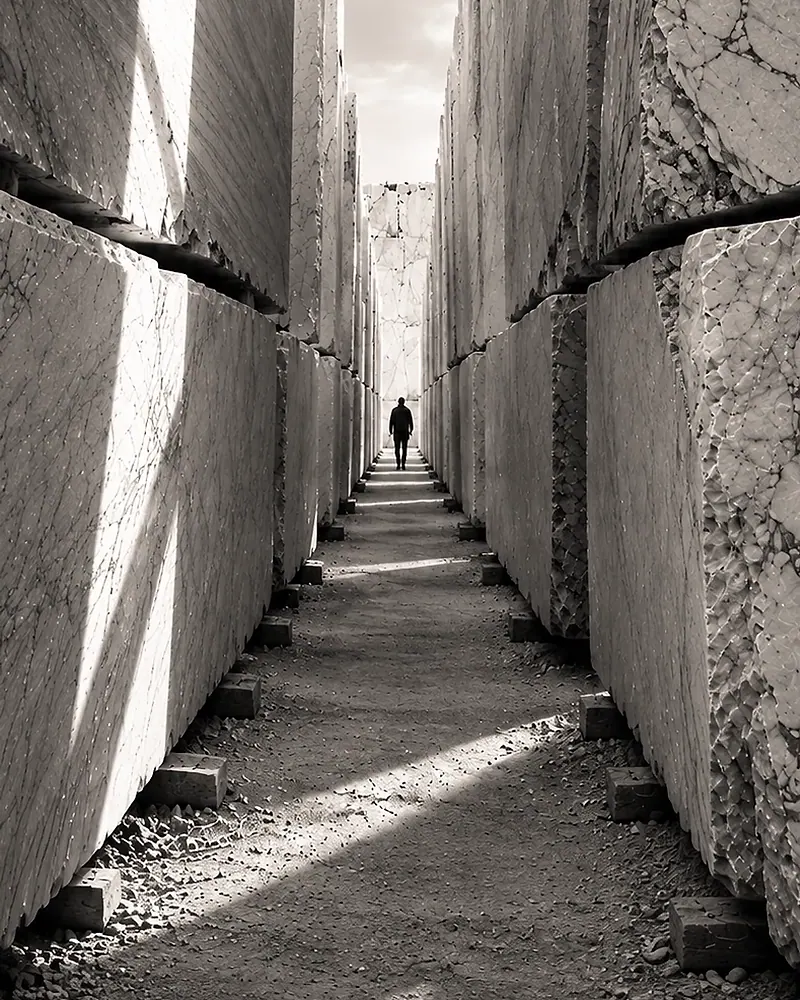
The natural-stone market approaches the final quarter of 2026 with conflicting signals. Commercial forecasters anticipate expansion, while the US Geological Survey reports weakening US dimension-stone sales since 2022. Growth expectations and difficult trading conditions can coexist; neither should be mistaken for a universal market verdict.123
For importers, processors and architects, the useful questions are more specific: which products are moving, where fabrication takes place, and what an offered block can become. Recorded trade and forecasts are kept apart below, each with its date.
Market size: read the boundary before the number
Grand View Research estimates the natural-stone market at US$11.2 billion in 2026. Mordor Intelligence puts it at US$39.64 billion. Both anticipate growth, but their published valuations differ too widely to serve as interchangeable measurements. These are commercial estimates, not an official global census.12
The inconsistency becomes sharper in Grand View Research’s separate marble study, which estimates US$77 billion for 2026, more than either cited estimate for all natural stone. The public summaries do not establish a satisfactory reconciliation. Differences in scope, valuation or modeling may contribute, but the cause remains unresolved. Averaging these figures would conceal the problem.124
Production rankings deserve similar restraint: the USGS 2026 summary lists world dimension-stone production as unavailable. For investment or purchasing decisions, use a defined product, geography and reporting period before adopting a market total.3
Trade shows the division between quarrying and processing
Customs statistics provide firmer evidence of recorded cross-border activity, although they exclude domestic sales. WITS generally values exports on an FOB basis and imports on a CIF basis; re-exports and re-imports are included. Export and import totals therefore should not be treated as identical measures.5
Product definitions matter just as much. HS 251512 covers marble and travertine merely cut into rectangular blocks or slabs. HS 680291 covers other worked marble, travertine and alabaster building or monumental stone. Neither category identifies white marble or a particular commercial grade.6
| Selected 2024 trade flow | Reported value, US$ million |
|---|---|
| HS 251512 imports: China; India | 1,065.59; 294.517 |
| HS 251512 exports: Turkey; Italy | 585.92; 148.698 |
| HS 680291 exports: China; Italy; Turkey | 1,161.38; 844.42; 675.879 |
| HS 680291 imports: United States | 1,278.0110 |
China’s substantial imports of merely cut material alongside exports of worked stone are consistent with a major processing role. India is also a significant buyer of material for further processing. These are interpretations of separate trade flows, not a tracing of individual blocks from quarry to final destination.79
Other countries become more visible when the product changes. In 2024, Egypt exported US$372.54 million and Greece US$161.06 million under HS 680221, the simply cut or sawn marble-family category. Under HS 680293, other worked granite, Brazil exported US$319.18 million, India US$154.29 million and Spain US$85.61 million. A marble-only comparison would miss part of their commercial position.1112
For buyers, the implication is practical: assess quarry origin and processing capability separately. The country dispatching a finished product does not, by itself, establish where the stone was extracted.5
Architectural demand needs a project-level reading
Hospitality offers a visible development pipeline. Hilton’s 2025 review reports more than 520,000 rooms under development and more than 500 additional luxury and lifestyle properties in its pipeline. This indicates potential work for building-material suppliers; it does not identify marble specifications, purchasing dates or guaranteed openings.13
Residential evidence also needs careful translation. In NKBA’s 2026 kitchen-trends release, 75% of respondents identified slab or solid-surface backsplashes as gaining popularity. Natural quartzite scored strongly for countertops and backsplashes, behind quartz. Those findings concern surveyed expectations and several competing materials. They are not marble market shares or proof of a worldwide shift towards white interiors.14
A useful specification must therefore connect appearance to use. Marble’s sensitivity to acidic substances matters in kitchens and hospitality service areas; an impregnating sealer can improve stain resistance without preventing acid etching. Discuss expected spills, cleaning products and acceptable surface ageing before approving the finish.15
For a supplier, the better commercial question is whether the proposed stone fits the project’s exposure and maintenance plan. A large hotel pipeline cannot answer that question.1315
White-marble economics begin with usable output
The customs categories above cannot establish a like-for-like white-marble price. Their values combine materials and processing stages, while gross trade values are not quarry prices or producer margins. An importer should compare specified offers rather than infer a block price from an aggregate export average.56
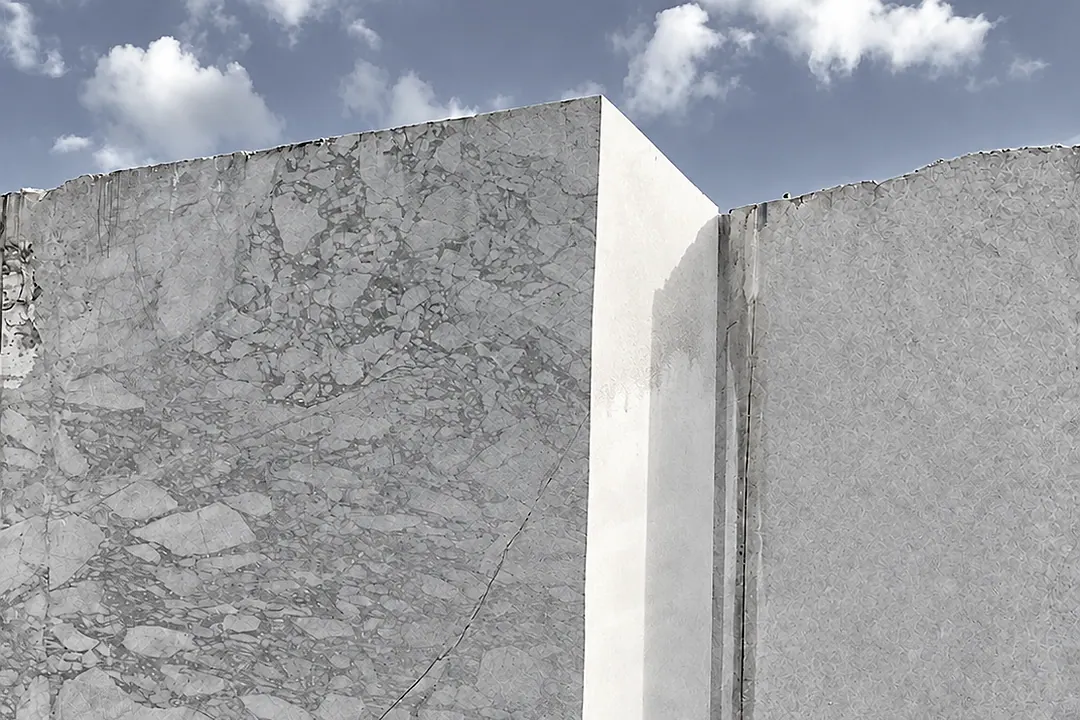
Start with the measurement basis. EN 1467 distinguishes gross, net and commercial block dimensions. A quotation based on the enclosing volume and one based on an agreed usable form are not automatically equivalent, even when both state a price per cubic metre.16
Then examine the cutting plan. Research on dimension-stone extraction shows that fracture spacing and orientation constrain recoverable block geometry. The purchasing implication is that a cheaper tonne can yield a more expensive acceptable slab when trimming or fractures reduce recovery.17
Large-format ambitions make the question sharper. Breton publishes multiwire configurations accommodating blocks up to 3,700 mm long and 2,200 mm high. Those are machine capacities, not guaranteed finished-slab dimensions or evidence that a particular quarry has suitable inventory.18
Ask the receiving processor to assess the selected block against the intended slab dimensions and cutting direction. Compare acquisition, delivery and processing costs against expected acceptable output, with recovery assumptions stated explicitly. The relevant purchase is the stone that can meet the order after fabrication.1617
Iran: distinguish historical markets from present execution
Iran’s trade illustrates why broad national labels can mislead. In 2022, China bought US$27.469 million of Iran’s US$40.787 million exports under HS 251511, crude or roughly trimmed marble and travertine. In 2023, Iraq bought US$47.965 million of Iran’s US$69.467 million exports under HS 680291. These are different products and years, not competing answers to one current market ranking.1920
The published figures do not settle the current split between rough-block and processed-stone exports. A September 2025 Iran Stone Association interview emphasized processed exports, while identifying equipment, investment and dependable project orders as constraints on further growth. Its statements were not accompanied by a reconciled customs calculation.192021
For procurement, distinguish commercial interest from transaction feasibility. OFAC’s guidance on Executive Order 13902 covers Iran’s mining and manufacturing sectors and identifies potential sanctions exposure. Buyers should follow the laws of their own jurisdiction and applicable transaction requirements; a general sector description cannot determine the status of an individual purchase.22
Shipping needs a separate, current check. Maersk’s 23 September 2026 Middle East update records booking restrictions and changing service arrangements. It does not confirm an available route for a particular Iranian stone shipment. Obtain current carrier acceptance and delivery assumptions before committing to a project programme.23
Engineered-stone restrictions change the comparison
Australia prohibited the manufacture, supply, processing and installation of covered engineered-stone benchtops, panels and slabs from 1 July 2024, followed by an import prohibition from 1 January 2025. The definition includes artificial products containing at least 1% crystalline silica and meeting other criteria; resin-free porcelain and sintered products are excluded.24
That creates a reason to reassess material choices, but it does not quantify a transfer of demand to marble. Other compliant alternatives remain available. Nor is “natural” a workplace-safety specification: the 2026 OSHA/NIOSH alert distinguishes generally low-silica carbonate stones from higher-silica materials, while requiring material-specific assessment and appropriate exposure controls. A particular marble’s composition cannot be established from its colour or trade name.2425
Importers should request material information sufficient for the intended market and fabrication process. Architects should compare the actual alternatives on appearance, performance, maintenance and compliance, rather than treating a regulatory change as an automatic endorsement.152425
Environmental evidence belongs in the buying decision
Natural stone has industry-wide environmental product declarations covering cladding, flooring and countertops, published by the Natural Stone Institute in 2022. These disclose impacts within defined boundaries; they do not assign the same footprint to every quarry or product.26
The institute’s comparisons show lower production-stage emissions for stone than selected alternatives in the assemblies studied. Applying that finding to a project requires comparable function, thickness and lifecycle boundaries, with transport, fabrication losses and installation considered where relevant. An overseas block purchase needs its own assumptions, not a borrowed percentage saving.2627
The buying discipline for the remainder of 2026 is to make each assumption reviewable: product category, measured block, intended output, acceptance criteria and deliverable shipment. Growth forecasts can inform strategy; they cannot replace that evidence.1161723
For MAMSALEH rough-block inquiries, discuss dimensions, background and veining through the WhatsApp or phone contacts on mamsaleh.com; selection is subject to quarry availability.28
Sources
Superscript numbers in the text refer to these sources. Web-source access date: 2026-09-29. Publication or update dates are shown where established.
- 1Grand View Research. Natural Stone Market, 2026–2033 (opens in a new tab). Updated July 2026.
- 2Mordor Intelligence. Natural Stone Market (opens in a new tab). Updated 2026-01-28.
- 3US Geological Survey. Mineral Commodity Summaries 2026 (opens in a new tab), dimension-stone chapter. 2026.
- 4Grand View Research. Marble Market, 2025–2030 (opens in a new tab). Published May 2025; updated July 2026.
- 5World Bank WITS. Country Analysis: trade-data methodology (opens in a new tab). Undated.
- 6US Census Bureau. Schedule B, Chapter 25 (opens in a new tab), 2017 edition; Schedule B, Chapter 68 (opens in a new tab), 2021 edition. Commodity definitions.
- 7World Bank WITS / UN Comtrade. HS 251512 imports by country, 2024 (opens in a new tab). Dynamic database.
- 8World Bank WITS / UN Comtrade. HS 251512 exports by country, 2024 (opens in a new tab). Dynamic database.
- 9World Bank WITS / UN Comtrade. HS 680291 exports by country, 2024 (opens in a new tab). Dynamic database.
- 10World Bank WITS / UN Comtrade. HS 680291 imports by country, 2024 (opens in a new tab). Dynamic database.
- 11World Bank WITS / UN Comtrade. HS 680221 exports by country, 2024 (opens in a new tab). Dynamic database.
- 12World Bank WITS / UN Comtrade. HS 680293 exports by country, 2024 (opens in a new tab). Dynamic database.
- 13Hilton. 2025 Year in Review (opens in a new tab). Annual reporting; data as of 2025-12-31.
- 14National Kitchen & Bath Association. 2026 Kitchen Trends Report release (opens in a new tab). 2025-09-16.
- 15Natural Stone Institute. Care and Cleaning of Natural Stone (opens in a new tab). Undated.
- 16CEN / Slovenian Institute for Standardization, via iTeh. EN 1467:2022: Natural stone: Rough blocks: Requirements (opens in a new tab). 2022.
- 17Mosch et al.; Environmental Earth Sciences, Springer Nature. Optimized extraction of dimension-stone blocks (opens in a new tab). Published online 2010-11-30; 2011 journal issue.
- 18Breton. Paragon multiwire machine (opens in a new tab). Undated manufacturer specifications.
- 19World Bank WITS / UN Comtrade. Iran HS 251511 exports by destination, 2022 (opens in a new tab). Dynamic database.
- 20World Bank WITS / UN Comtrade. Iran HS 680291 exports by destination, 2023 (opens in a new tab). Dynamic database.
- 21Tasnim News Agency. Interview with Iran Stone Association secretary on exports and industry constraints (opens in a new tab). 2025-09-27; Persian.
- 22US Department of the Treasury, Office of Foreign Assets Control. FAQ 831: sectors of Iran’s economy under Executive Order 13902 (opens in a new tab). Dated 2020-12-07; current guidance consulted.
- 23Maersk. Middle East Operational Update 49 (opens in a new tab). 2026-09-23.
- 24Safe Work Australia. Engineered-stone ban (opens in a new tab). Current regulatory overview.
- 25OSHA / NIOSH. Worker Exposure to Silica during Countertop Manufacturing, Finishing, and Installation (opens in a new tab). 2026; publication 2026-101.
- 26Natural Stone Institute. Industry-wide environmental product declarations announcement (opens in a new tab). 2022-10-27.
- 27Natural Stone Institute. Embodied Carbon and Natural Stone (opens in a new tab). Undated; EPD-based comparisons.
- 28MAMSALEH. Scatto & Bianco: product and supply information. mamsaleh.com, 2026.