Natural stone vs engineered stone after the silica bans
Compare natural and engineered stone through product eligibility, fabrication exposure and finished-surface performance. See what importers, processors and architects should verify before choosing a replacement.
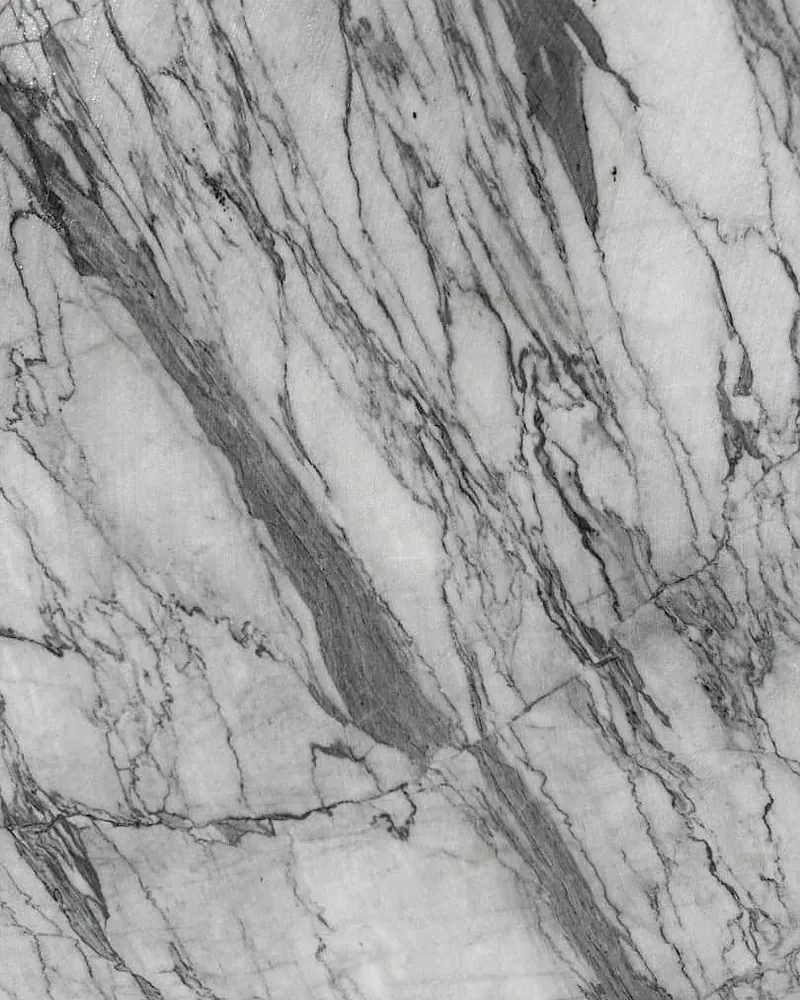
Australia’s restrictions on engineered stone have changed which surfaces can be supplied and installed for a project: covered benchtops, panels and slabs are subject to domestic and import prohibitions. Those rules concern a defined product category, not every stone surface.12
For an importer, processor or architect, the useful comparison now has three parts: whether the product is permitted, how it can be fabricated with controlled exposure, and whether it will perform in its intended application. Treat these as separate approval decisions. A favourable answer to one does not settle the others. Australia’s post-ban review reinforces this approach by calling for continued risk management when processing all types of stone.4
What Australia actually prohibited
The prohibition on manufacturing, supplying, processing and installing covered engineered-stone benchtops, panels and slabs began on 1 July 2024. For this purpose, engineered stone is an artificial product containing at least 1% crystalline silica by weight, made by combining natural stone materials with other chemical constituents, and becoming hardened. The percentage is only one part of the definition.1
Natural stone falls outside that artificial-product definition. Porcelain and sintered stone containing no resin are specifically excluded; artificial stone containing less than 1% crystalline silica also falls outside the definition. These distinctions establish the scope of this prohibition, not a declaration that processing the alternatives is harmless.14
The import prohibition followed on 1 January 2025. Australian Border Force guidance addresses product testing and border enforcement, including the use of petrographic analysis and X-ray diffraction. For an importer evaluating a replacement surface, the practical recommendation is to establish its identity and supporting evidence before committing to a shipment.2
Use the Australian rules for Australian decisions. For other destinations, check the applicable local requirements rather than treating the phrase “silica bans” as a worldwide legal classification.
Marble, quartzite and engineered stone are different propositions
The OSHA/NIOSH countertop hazard alert explains that carbonate-based marble and limestone generally contain little or no crystalline silica, whereas quartzite and some engineered stones can contain much higher concentrations. It also records substantial variation within the engineered-stone category. Neither “natural” nor “engineered” identifies a single composition.3
That distinction deserves attention at the sample table. A crystalline appearance does not establish crystalline-silica content, and a natural quartzite should not be assigned marble’s general composition. Exact crystalline-silica content requires analysis; the alert identifies petrographic and X-ray diffraction methods. Ask for evidence tied to the actual stone or manufactured product under consideration.3
There is a second distinction: the proportion of crystalline silica in a solid product is not a measurement of a worker’s airborne exposure. The UK’s Health and Safety Executive identifies the stone, tools, task duration, extraction, respiratory protection and workshop arrangements as factors influencing exposure. Substituting a material therefore calls for a review of the work process as well as the product information.5
A replacement material still needs a fabrication plan
Silica-related disease is an occupational-health issue extending across natural and engineered stone processing. Inhaled respirable crystalline silica can cause silicosis, an incurable and potentially fatal lung disease. Product substitution must sit within an effective exposure-control programme.3
For a processor, start the review at the actual operation: primary sawing, edge finishing, drilling, polishing and cleanup. HSE’s guidance makes clear that workshop organisation and segregation of dusty activities matter alongside tool controls. Include nearby workers in the assessment rather than considering only the person holding the tool.56
Water suppression is important, but a wet blade is not proof that exposure has been adequately controlled. HSE specifically warns that harmful dust may remain even when little is visible. Its wet-cutting guidance also calls for respiratory protective equipment when cutting stone.6 Have a competent occupational-health and safety professional assess exposure and the effectiveness of controls for the task.3
The post-ban review published by Safe Work Australia on 4 December 2025 found the prohibition operating as intended, while noting that implementation remained at an early stage. It also highlighted the need to manage risks from processing alternatives. That is a more useful purchasing message than a blanket assurance that the next generation of surfaces is safe.4
Ask for evidence that answers the purchasing decision
Match each decision to the evidence that answers it.
| Decision | Evidence to request |
|---|---|
| Is the product eligible for this destination? | Its composition, manufacturing description and assessment against the applicable product rules.2 |
| Can the processor control exposure? | A task-specific assessment covering tools, extraction, respiratory protection and workshop practices.5 |
| Will the marble meet the design requirements? | Representative physical-property results and any additional application-specific testing.79 |
| What appearance is being purchased? | Actual slab images, approved layout and an agreed range of natural variation.10 |
| What does a block quotation measure? | Identified blocks and an explicit agreement on gross, net or commercial dimensions.11 |
Keep the evidence connected. For example, a report on one material should not silently become the technical basis for a differently identified shipment. A photograph approved for colour should not become approval of strength or fabrication conditions. Record which decision each document supports, who reviewed it and what remains to be established.
The architectural comparison still includes maintenance
Assess a permitted engineered surface against its own technical documentation and samples. Apply the same standard of proof to marble. Regulatory eligibility should open the specification review; it should not decide the finish, maintenance regime or installation detail.
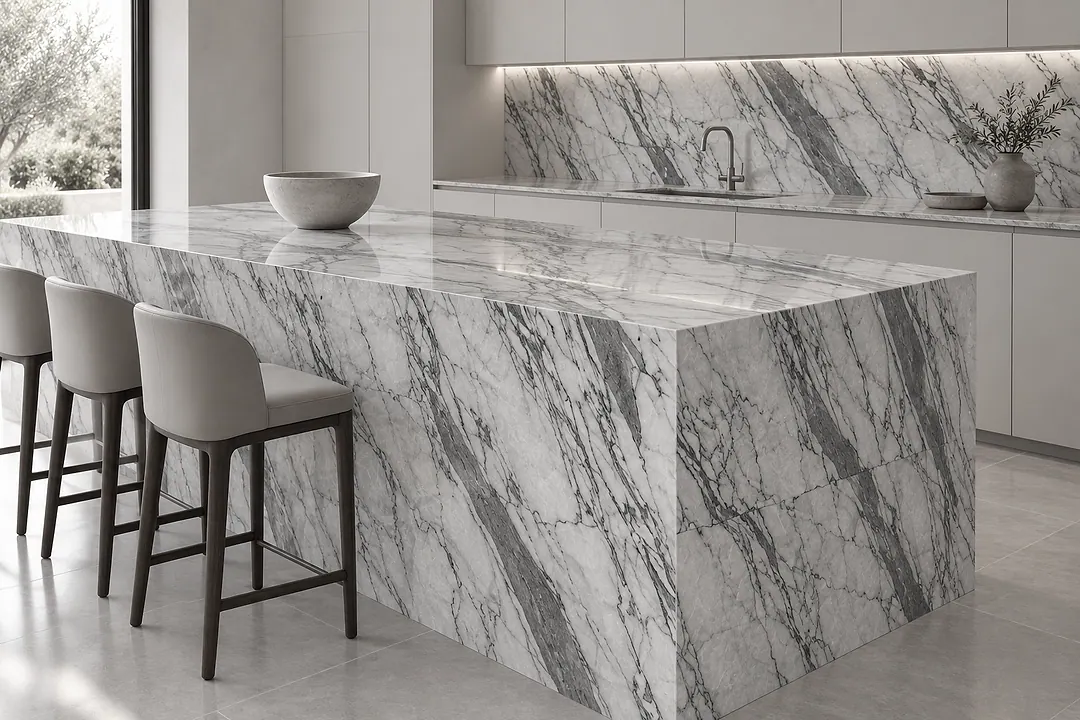
Marble’s composition has consequences in service as well as during processing. Acidic substances, including lemon juice, vinegar and some cleaners, can etch calcareous stone. Etching alters the surface; staining concerns discolouration. An impregnating sealer can improve stain resistance, but does not make marble stain-proof or provide ordinary protection against acid etching.8
Consider a hotel feature wall and a food-service counter as a hypothetical specification exercise. For the wall, begin with the slab arrangement, fixings and cleaning access. For the counter, add trials using expected spills and the operator’s proposed cleaning products. Agree the acceptable appearance after use before approving the material.89
Structural and physical evidence belongs in the same review. ASTM C503/C503M-23 addresses marble dimension stone, including absorption, density, strength and abrasion requirements. Citing it in a specification does not establish that the offered stone complies. Request relevant results and assess them against the design.7
Additional questions depend on the assembly: slip resistance for walking surfaces, anchorage for cladding, and suitable exposure testing for exterior conditions. These are separate performance questions. A silica-content report cannot answer them.9
Natural pattern also requires an explicit acceptance process. Adjacent slabs can be book-matched into an approximately mirrored arrangement, but variation persists even between neighbouring cuts. Review actual slabs and proposed joints or openings; a digitally mirrored photograph is not evidence of an achievable match.10
For block buyers, compare usable output
Moving from a manufactured slab to rough marble also changes what the buyer must define. EN 1467:2022 distinguishes gross, net and commercial block dimensions. A quotation should make clear which measurement basis applies and how irregularities or defects are treated.11
Research on dimension-stone extraction shows that discontinuities influence recoverable block geometry. The commercial implication is that purchase price alone cannot establish cost per acceptable finished piece. Compare offers through a proposed cutting plan, allowing for trimming and the output the project will accept.12
Ask the receiving processor to review block dimensions, visible fractures, proposed cutting direction and intended slab layout before selection is final. Keep the agreed block identity attached to that review. Where a project depends on a continuous composition, approve the resulting slab sequence before releasing fabrication.1011
Environmental comparisons need their own evidence
In the Natural Stone Institute’s published countertop comparison, natural stone records 46.8 kg CO₂e per square metre, against 102.6 kg CO₂e for engineered quartz. The boundary is A1–A3: raw-material supply, associated transport and manufacturing. The stone figure uses an industry-wide environmental product declaration; the quartz figure averages declarations from three manufacturers.13
These are association-assembled comparisons of specified datasets, not carbon footprints for every available stone. They cannot establish a footprint for a particular Iranian marble. For procurement, compare equivalent functions and thicknesses, then account for project transport, fabrication losses, installation and the other life-cycle stages relevant to the decision. The published figures support a bounded comparison, not universal environmental superiority.13
Choose the material on its own evidence
The regulations establish the restrictions; they do not measure how much demand has moved to marble. Any expected sales increase should therefore remain a commercial hypothesis.1
MAMSALEH offers Scatto & Bianco, a bright white, crystalline natural stone with naturally formed veining from Aligoodarz, Lorestan, primarily as rough blocks. Selection is subject to quarry availability. That description does not establish silica content or laboratory performance.14
For block inquiries, contact MAMSALEH by WhatsApp or phone through mamsaleh.com.14
Sources
Superscript numbers in the text refer to these sources. Web-source access date: 2026-09-29.
- 1Safe Work Australia. Engineered stone ban (opens in a new tab). Current regulatory guidance; undated.
- 2Australian Border Force. Engineered stone: prohibited goods (opens in a new tab). Import prohibition, product scope and testing guidance.
- 3OSHA / NIOSH. Worker Exposure to Silica during Countertop Manufacturing, Finishing, and Installation (opens in a new tab). Publication 2026-101.
- 4Safe Work Australia. Review of the engineered stone prohibition (opens in a new tab). Published 2025-12-04.
- 5UK Health and Safety Executive. Silica dust: stonemasonry (opens in a new tab). Undated guidance.
- 6UK Health and Safety Executive. Wet cutting (opens in a new tab). Updated 2025-02-12.
- 7ASTM International. C503/C503M-23: Standard Specification for Marble Dimension Stone (opens in a new tab). 2023 edition.
- 8Natural Stone Institute. Care and Cleaning of Natural Stone (opens in a new tab). Undated.
- 9Natural Stone Institute. Natural Stone Testing Services (opens in a new tab). Live technical guidance.
- 10Karin Kirk; Use Natural Stone / Natural Stone Institute. Bookmatching: Geology Meets Geometry (opens in a new tab). Published 2018-12-21.
- 11CEN / Slovenian Institute for Standardization; iTeh preview. EN 1467:2022: Natural stone: Rough blocks: Requirements (opens in a new tab). 2022.
- 12Mosch et al.; Environmental Earth Sciences, Springer Nature. Optimized extraction of dimension stone blocks (opens in a new tab). Published online 2010-11-30; 2011 journal issue.
- 13Natural Stone Institute. Embodied Carbon and Natural Stone (opens in a new tab). Undated; industry-wide stone EPDs and selected alternative-product comparisons.
- 14MAMSALEH. Scatto & Bianco: product and supply information. mamsaleh.com, 2026.